
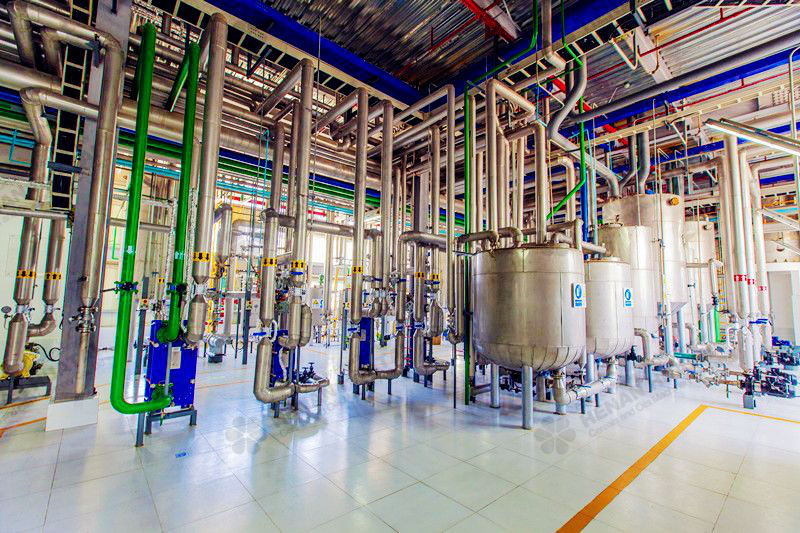
Choosing the right edible oil refining equipment starts with one simple question: What does the crude oil need to become stable, clean, and to be sold on the market? The answer depends on the type of oilseed, the content of gums, free fatty acids, waxes, color, smell, etc., and the required quality of the end product. Huatai Group can supply complete refining solutions that consist of a number of components, including the process route, the layout of the equipment, the degree of automation, the installation, and the commissioning of the equipment.
Why Edible Oil Refining Equipment Must Match the Crude Oil
Crude vegetable oil is not a single, predictable material. Soybean oil, palm oil, cottonseed oil, sunflower oil, rapeseed oil, and other oils can carry different proportions of phospholipids, free fatty acids, pigments, odor compounds, moisture, waxes, and trace impurities. Edible oil refining equipment has to remove those unwanted components while protecting oil yield, nutrition, flavor neutrality, and downstream stability.
Impurities Define the Refining Route
Crude oil goes through various processes, first removing hydratable and non-hydratable gums from the oil. Water degumming or acid-assisted degumming is typically conducted prior to neutralization or physical deacidification in order to condition the oil’s phospholipids. If gums are left in the oil, it will hinder the bleaching and deodorization processes, thereby affecting the end oil quality’s stability.
Free fatty acids are another major decision point. Chemical refining uses alkali neutralization to react with free fatty acids and separate soapstock. Physical refining relies on vacuum steam stripping during high-temperature deodorization, making pretreatment quality especially important because residual gums and metals can affect final oil color and stability.
Finished Oil Requirements Shape the Line
Market expectations for the end product should be given the same consideration as the crude oil. Cooking oil in retail bottles, industrial frying oil, salad oil, shortening, and palm olein or stearin fractions all have different requirements for odor, color, cold resistance, and clarity. Therefore, a reliable edible oil refinery is planned for the final application and not only for the seed or crude oil which is to be processed.
Core Equipment Across the Refining Process
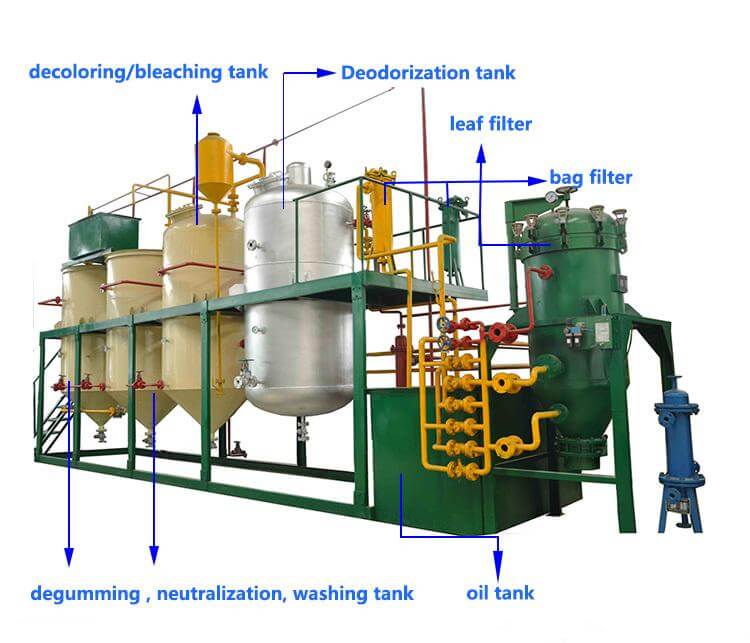
Most edible oil refining lines share several functional sections, although the configuration changes with raw material and production mode. Tanks, mixers, heaters, separators, vacuum dryers, filters, bleaching vessels, deodorization towers, heat exchangers, and control systems work together to move oil through a controlled sequence. Good oil refining machinery is not just stainless steel hardware; it is a managed flow of temperature, residence time, vacuum, chemical contact, and separation.
Degumming and Neutralization
The purpose of degumming equipment is to allow gums to hydrate, agglomerate, and then separate from the oil. In acid degumming, an acid, such as phosphoric or citric, is added to change non-hydratable phospholipids into a form that can be easily removed. The aim of degumming is to produce oil that is as clean as possible to enter the subsequent processing stages of bleaching earth and deodorization, in order to make these processes as efficient as possible.
Neutralization is another key step in chemical refining. Here, alkali is used to react with free fatty acids. At the same time, other impurities like pigments, residual gums, and trace impurities are removed from the oil. In order to keep refining loss as low as possible, neutralization has to be kept under control. Excessive reaction as well as inadequate separation have to be avoided. In Huatai Group, neutralization is not a standalone process but is integrated with washing, drying, and soapstock handling to ensure a stable process.
Vacuum Drying and Bleaching
Moisture control is essential before bleaching. Vacuum drying lowers water content so adsorbents can work efficiently and the oil can contact bleaching earth under controlled conditions. Bleaching then reduces pigments, oxidation products, soaps, and trace metals, improving color and preparing the oil for deodorization.
Deodorization and Optional Dewaxing
Deodorization removes odor compounds and remaining free fatty acids under vacuum with steam stripping. It is one of the most important stages for flavor neutrality, shelf stability, and consumer acceptance. A deodorization tower must support uniform oil distribution, efficient steam contact, heat recovery, and vacuum performance.
Physical and Chemical Refining Compared
The debate around physical vs chemical edible oil refining is popular, as both processes can yield high-quality edible oils, provided the correct crude oil is chosen for the respective process. Chemical edible oil refining offers considerable flexibility, as it is able to remove a wide variety of impurities. The main deacidification step is the neutralization of the crude oil with an alkali. Physical edible oil refining, in contrast, aims to reduce the amount of chemicals used in the refining process and the formation of soapstock. Physical refining, however, requires stronger pretreatment of the crude oil and a more sophisticated deodorization process.
When Chemical Refining Fits
Chemical refining can be applied when oil is to be alkali neutralized, for instance to deal with free fatty acids and other impurities. The process is preferred when crude oil composition can vary and when a well-established process is wanted with clear up- and downstream sections. Management of soapstock and washing stages is critical in order to keep an eye on refining loss and wastewater load.
When Physical Refining Fits
Physical refining of palm oil and other crude oils can be effectively carried out by pretreatment to remove gums and other contaminants, followed by physical refining methods. In physical refining, deacidification is carried out in the vacuum steam stripping section; thus, in deodorization, not only flavor is removed but also fatty acids are removed. This method is favorable for crude oils that are to be refined in an integrated refining line.
Batch, Semi-Continuous, and Continuous Configurations
A continuous oil refinery is often preferred to ensure constant production, exact quality of oil, heat recovery, and a minimum of manual interventions. A continuous process requires a great amount of process discipline. However, this way temperature, vacuum, retention time, and flow can be controlled much better. In comparison of long-term operating concepts, the companies learn that continuous refining is not only about one big unit, but above all about process management in a coordinated manner.
How Huatai Group Builds an Integrated Refining Solution
Huatai Group is a production-line solution provider for edible oil processing. We provide a total edible oil processing solution, from oilseed pretreatment and extraction to oil refining.
For a soybean oil production line, the selection conversation may focus on water or acid degumming, alkali neutralization, vacuum bleaching, and vacuum steam deodorization. For palm oil, the discussion may emphasize acid degumming, bleaching, physical refining, and fractionation. Huatai Group can help align these route choices with plant layout, automation, utility conditions, installation, commissioning, and long-term operation.
Conclusion
Edible oil refining equipment is selected on the basis of a process-oriented logic versus a list of generic machines. The most reliable refining process starts with an analysis of the crude oil to be refined. The most appropriate method of degumming and deacidification is then identified, and the process of bleaching and deodorization is tailored to the end product based on the specifications of the end product. The process can then be run in a batch mode, semi-continuous mode, or continuous mode based on the specific operating needs of the refinery. Value is added to decisions about an edible oil refinery plant by linking them to a complete solution for edible oil processing.
For building a cleaner, more stable, and more practical production line for edible oil, explore the refining solutions offered by Huatai Group.
FAQ
Q: What is the most important factor when choosing edible oil refining equipment?
A: The quality of the crude oil is the most important factor. It contains gum, free fatty acids, color, smell, wax, and moisture. This determines whether the line needs to be degummed more strongly, whether crude oil has to be chemically neutralized, whether it can be physically refined, whether it has to be deodorized, and whether it has to be dewaxed. The use of the finished oil is also very important. There is bottled oil, frying oil, and fractionated palm oil. Each of them has its own quality requirements.
Q: Is physical refining better than chemical refining?
A: It depends on the case. In the physical refining route, crude oil has to be properly pretreated and deacidified by vacuum steam stripping prior to desulfurization and other treating steps. In the chemical refining route, crude oil is deacidified by neutralization with alkali. Chemical refining can handle some variable crude oils well, but the better choice would depend on oil type, impurity profile, operating priorities, and required finished-oil standard.
Q: When should a plant consider a continuous oil refinery?
A: A continuous oil refinery is typically suitable for a plant that requires constant operation, constant quality, automation, heat recovery, etc., and requires constant flow. For example, for long-term production of the same oil, as opposed to constant change of oil types and quantity, e.g., in batch or semi-continuous mode.
Q: Can Huatai Group support different oil applications?
A: Yes. Huatai Group provides integrated edible oil processing solutions that can be matched to applications such as soybean oil, palm oil, and other vegetable oils. The suitable configuration depends on the crude oil and finished product, so the solution may combine degumming, neutralization, or physical refining, bleaching, deodorization, and optional dewaxing or fractionation.