
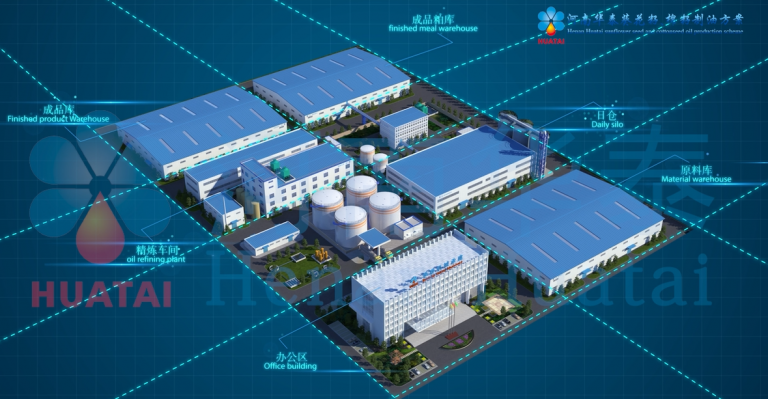
The core mission of the Huatai Edible Oil Refinery is to subject crude oil—whether obtained through pressing or solvent extraction—to a rigorous purification process. Crude oil contains impurities such as phospholipids, free fatty acids, pigments, and odor-causing substances; these not only compromise the oil’s taste and appearance but may also pose potential safety risks. Through a series of meticulous procedures—including degumming, deacidification, decolorization, and deodorization—the refinery eliminates these harmful impurities while simultaneously maximizing the retention of the oil’s inherent nutritional value.
Degumming constitutes the initial step of the refining process, primarily aimed at removing phospholipids from the crude oil. At high temperatures, phospholipids can cause the oil to foam and smoke—impairing the cooking experience—and also diminish the oil’s overall stability. The refinery typically employs a hydration degumming method, adding a precise amount of hot water to the crude oil; this causes the phospholipids to absorb water, swell, and subsequently precipitate out, thereby laying a solid foundation for the subsequent refining stages.
Deacidification serves to reduce the content of free fatty acids within the oil. Free fatty acids impart an acidic or acrid taste to the oil and accelerate its oxidative deterioration. The refinery predominantly utilizes an alkaline refining method for deacidification, introducing food-grade alkali solution to neutralize the free fatty acids; this reaction generates “soapstock,” which is then separated and removed, effectively enhancing both the stability and flavor profile of the oil.
Following degumming and deacidification, the oil undergoes a decolorization treatment. Pigments present in the crude oil—such as chlorophyll and carotenoids—can cause the oil to appear dull or dark, thereby detracting from its visual appeal. The refinery employs adsorbents—such as activated bleaching earth—to adsorb these pigments under carefully controlled conditions of temperature and pressure, rendering the oil crystal-clear and transparent, and significantly improving its marketability.
Deodorization represents the final, critical stage of the refining process, designed to eliminate odor-causing substances from the oil. These odors primarily originate from the oxidative byproducts of the oil itself, as well as from volatile compounds inherent in the raw materials. The refinery utilizes vacuum distillation technology for deodorization; by subjecting the oil to high-vacuum and high-temperature conditions, volatile odor compounds are vaporized and separated, resulting in an oil with a pure, neutral aroma that will not interfere with the authentic flavors of dishes during cooking.
Today, the Huatai Edible Oil Refinery is actively advancing toward a future characterized by intelligent and eco-friendly operations. Its intelligent production lines are equipped with state-of-the-art monitoring systems capable of tracking key parameters—such as temperature, pressure, and flow rates—in real time across every stage of the process, thereby guaranteeing the consistent quality of every single batch of product.
Interested in Our Equipment?
Get a customized proposal for your oil processing project — from plant design to installation.