
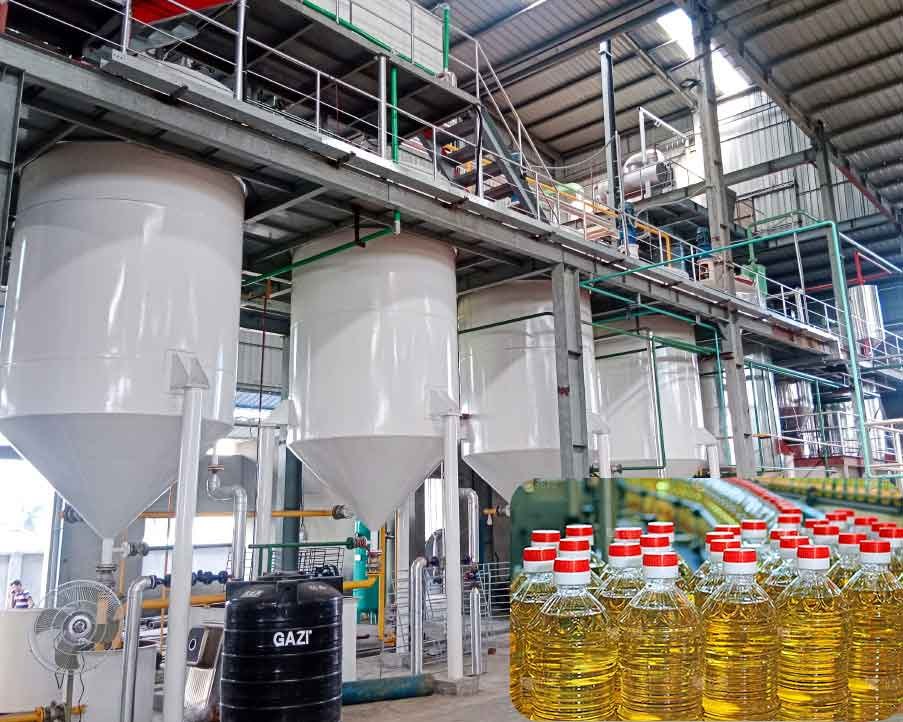
Edible oil refining equipment improves crude soybean oil, palm oil, and other vegetable oils by removing gums, free fatty acids, pigments, odor compounds, moisture, and waxes before the oil reaches food or industrial use. The practical choice is the route that fits crude oil quality, final oil purpose, production rhythm, and the way each refining section works together. Huatai Group approaches this as a complete process decision, from degumming and deacidification to bleaching, deodorization, and optional dewaxing or fractionation.
Why Edible Oil Refining Equipment Depends on Crude Oil Quality
Raw vegetable oils are fluctuating materials and cannot be considered fixed raw materials. Examples of such materials are soybean oil, palm oil, rapeseed oil, sunflower oil, rice bran oil, corn germ oil. These materials contain varying amounts of phospholipids, free fatty acids, color bodies, waxes, moisture, and odor, which demand specific pretreatment prior to processing.
A proper edible oil refinery will keep a product stable and prevent any unnecessary loss. If gums remain in the oil after bleaching, deodorization has to work extra hard to compensate for this lack of quality.
Gums and Free Fatty Acids Set the Direction
The degumming step, often the first major step in oil refining, aims to remove the phospholipids, which could otherwise cause problems in subsequent steps of oil refining. Degumming, which is often performed with the addition of water and/or by using acid, is a way to ‘condition’ these impurities so that they can be easily separated from the oil.
Free fatty acids then shape the decision between physical refining and chemical refining. Chemical refining reacts free fatty acids with alkali and removes the resulting soapstock. Physical refining removes free fatty acids mainly during high-vacuum steam stripping in deodorization, so the quality of pretreatment becomes especially important.
Physical Refining and Chemical Refining in Practice
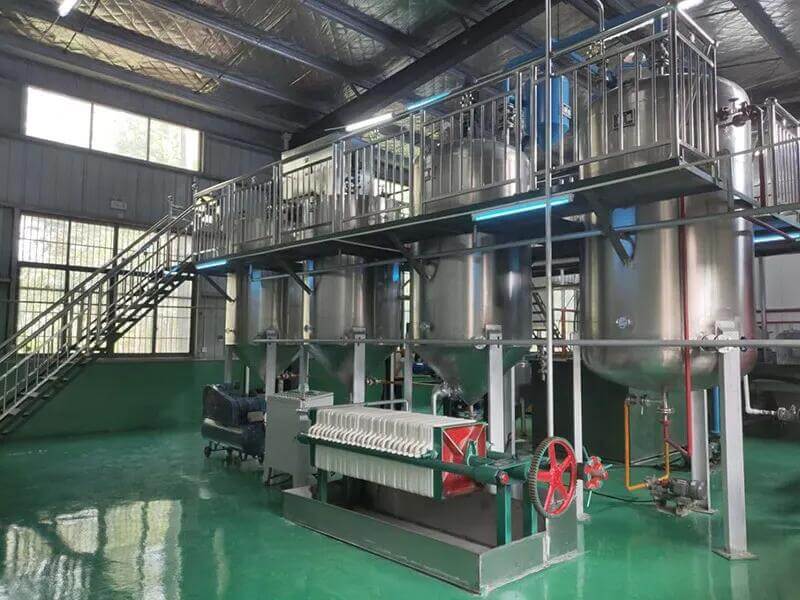
Physical refining and chemical refining are both parts of modern oil refining units. The two approaches solve deacidification in different ways. Selection of the appropriate approach depends on the type of crude as well as on the relative importance of alkali neutralization and steam stripping in the processing line.
When Physical Refining Fits
For crude oils that can be effectively degummed and bleached prior to deodorization, physical refining can be very attractive. The deodorization section not only removes odor from the oil, but also, under vacuum, strips free fatty acids from the oil. Thus, vacuum performance, heat recovery, steam contact, and residence time in the deodorization section all affect the quality of the finished oil.
Physical refining of palm oil is often considered. In physical refining of palm oil, the crude oil must be properly prepared by degumming and bleaching. The process reduces soapstock formation but demands more from the front-end processing.
When Chemical Refining Fits
Chemical refining using alkali neutralization is valuable where control of the crude oil is required. Chemical refining is particularly suitable for oils high in free fatty acids and other impurities which require a clear separation step prior to the bleaching and deodorization steps. Chemical refining is also useful in plants processing variable quality oils and requiring flexibility in operation.
Of course, there is a trade-off: the neutralization, washing, and drying steps must be done in a certain way in order to keep an eye on the refining loss. Too much alkali, too little separation, and a drying process that is too unstable, for example, can lead to problems with the subsequent filtration step.
Core Sections That Shape Finished Oil Quality
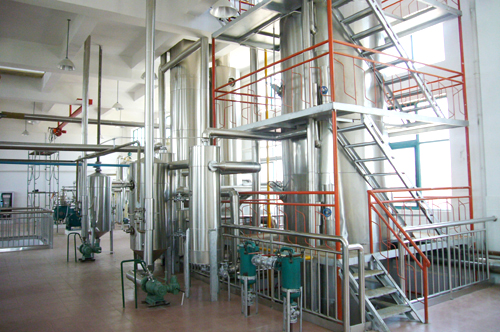
A refining line consists of sections which must be coordinated. These sections include tanks, mixers, heaters, separators, vacuum dryers, bleaching vessels, filters, deodorization towers, heat exchangers, and control systems that have to control temperature, vacuum, contact time, moisture, and flow.
Degumming, Neutralization, and Drying
Degumming removes gums from crude oil to prevent them from affecting color, flavor, and stability. Neutralization removes free fatty acids in chemical refining. Washing and drying remove soap and moisture before bleaching.
Bleaching and Deodorization
Bleaching removes pigments, residual soap, trace metals, and other oxidation products by contact with adsorbents and subsequent filtration. Deodorization is carried out by vacuum and steam stripping of odor-causing compounds and other volatile substances. In a continuous oil refinery, these stages are favored by a constant flow, heat exchange, and automation of the process.
A continuous oil refinery is most relevant for a plant that is seeking to run at constant throughput and quality over extended periods of time. Batch and semi-continuous configurations are more relevant for product diversity, short schedule lengths, and frequent changes of raw oil.
Soybean and Palm Oil Need Different Refining Logic
The use of soybean oil and palm oil is widespread, and both go through a refining process. While both oils are typically refined, the processes that are emphasized can vary significantly. Typically, for soybean oil, degumming, deacidification, decolorization, and deodorization are key steps. For palm oil refining, the refining process is often connected to fractionation, where the resulting oil is split into liquid and solid fractions.
In producing soybean oil, consideration should be given to the refining of the oil as part of the overall production of crude oil prior to preparation for consumption as edible oil. Good pretreatment will help to ease the load on the refining section to produce a stable edible oil. Similar consideration should be given to the production of palm oil, where fractionation can be carried out after refining to produce palm olein and palm stearin for specific use.
Applications Beyond Soybean and Palm Oil
Similar refining methods are applied to rapeseed, sunflower, cottonseed, rice bran, peanut, sesame, corn germ, and other specialty oils. In some cases, wax removal is required in order to achieve the necessary low-temperature clarity.
Here, edible oil refining equipment is converted into an application-specific plant. When necessary, the process can be extended by dewaxing, winterization, or even fractionation. This is based on the oil’s composition and the intended use.
How Huatai Group Fits the Solution Stage
Huatai Group is relevant as it has production lines and relevant refining machinery, such as edible oil production lines. Various refining routes can be linked to relevant equipment layout, production capacity, automation, etc., including installation, commissioning, and operation. Typically, there are batch-type, semi-continuous type, and continuous type refinery configurations.
Develop a refinery line using the process steps and corresponding equipment in a logical order as created by Huatai Group.
Conclusion
Edible oil refining equipment creates value when every stage of the refining process is optimized for the crude oil being processed and the intended use of the end product. Therefore, physical refining can be efficient when a strong pretreatment is used and the deodorization is designed for deacidification. Chemical refining offers a reliable way of controlling the refining process by means of alkali neutralization. For each of the oil types, such as soybean oil, palm oil, rice bran oil, sunflower oil, etc., a specific route needs to be designed in order to remove the corresponding impurities and to produce the desired product.
Huatai Group brings you more practical value when treating refining as an integral part of the production line instead of as a group of separate vessels.
To learn more about Huatai Group’s refining solutions to build up a production line for edible oil that is cleaner, more stable, and more adaptable, please contact us.
FAQ
Q: What does edible oil refining equipment remove from crude oil?
A: What does edible oil refining equipment do? It removes gums, free fatty acids, pigments, odor compounds, moisture, waxes, residual soap, and trace impurities from oil. The exact process depends on the oil in question and can include degumming, neutralization or physical deacidification, bleaching, deodorization, drying, dewaxing, or fractionation.
Q: Is physical refining better than chemical refining for vegetable oil?
A: Physical refining is not necessarily better than chemical refining. Physical refining of crude oil can be very successful when the crude oil is degummed and bleached prior to the deodorization step. The chemical refining process, on the other hand, can offer excellent control by alkali neutralization. However, the better route to refine crude oil is dependent on the crude oil characteristics, the FFA level, the impurities in the crude oil, and the finished oil requirements.
Q: Why does soybean oil refining need careful degumming?
A: Soybean oil may contain phospholipids that can affect refining steps. Degumming is critical to minimize the gums that can affect the subsequent steps of deacidification, bleaching, and deodorization. Removing the gums in the degumming step improves process stability and results in a better-quality final product of soybean oil, i.e., better clarity, smell, and edibility.
Q: When does a refinery line need dewaxing or fractionation?
A:Dewaxing or winterization is used to remove wax from oil, which becomes cloudy at lower temperatures. This is especially true for sunflower oil, corn germ oil, and rice bran oil. Fractionation is typically used for palm oil in order to produce liquid and solid fractions for use in various applications.