
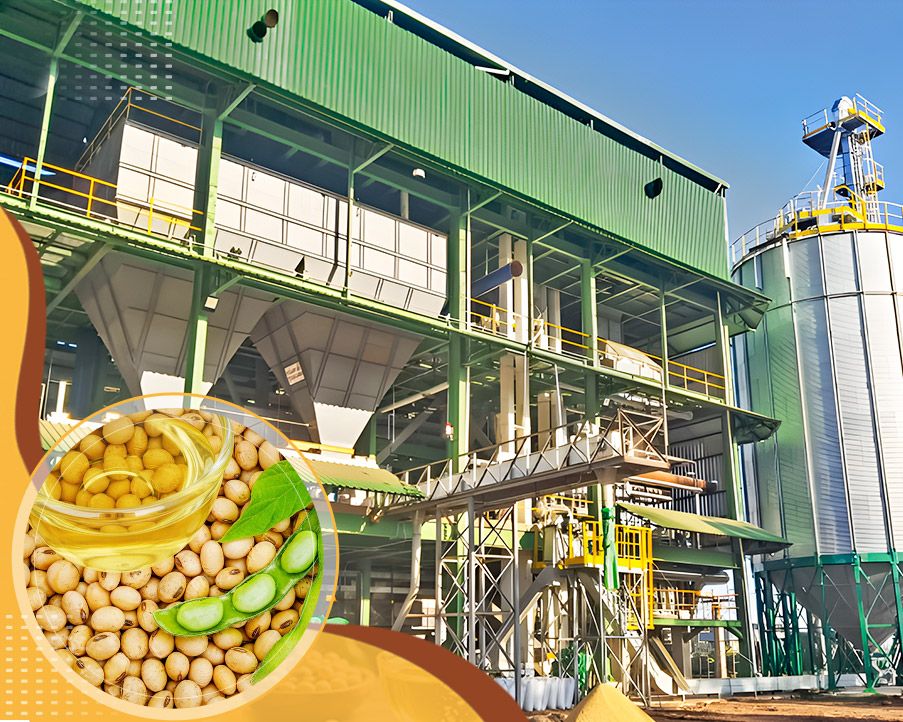
The world consumption of oils is growing, thus making soybean oil one of the most produced oils in the world. It becomes extremely important to be successful in such a competitive environment by means of the implementation of innovative engineering and high-efficiency machinery. The process of getting the maximum yield with minimal expenses becomes possible only through a well-thought-out process of soybean oil production.
Modern Standards in a Leading Soybean Oil Machine Factory
The manufacturing of good quality edible oil starts from the precision of the manufacturing plant itself. The first is a state-of-the-art factory of soybean oil machines, like the one owned by Huatai Group, which creates the industrial foundation required for mass manufacturing. It covers an area of 100,000 square meters and has 12 intelligent manufacturing workshops with laser cutting machines, CNC drilling, and welding robots to meet all international standard requirements.
Efficiency is achieved through engineering excellence. Contemporary factories value the scientific management system combining research, development, and precise manufacturing. Through this, it is possible to manufacture unique soybean oil machine units able to work stably under various climatic conditions all around the world.
Pretreatment as the Foundation of High-Yield Production
Efficiency in soybean oil manufacturing is largely determined during the pretreatment phase. The primary objective is to prepare the seeds for optimal oil release by adjusting their physical state and removing non-oil components. This stage is critical because it protects downstream soybean oil processing machine units from wear and tear while ensuring a high-quality crude oil output.
Cleaning and Conditioning Tower Operations
The process starts with thorough cleaning to remove large impurities, stones, and magnetic metals. Huatai Group utilizes specialized cleaning screens and magnetic separators to ensure raw material purity. Following cleaning, a conditioning tower or vertical cooker is employed to adjust the moisture and temperature of the soybeans. This softening process makes the soybeans more plastic, facilitating the subsequent separation of oil from the embryos.
Crushing and Flaking Dynamics
After conditioning, the soybeans enter a crusher to increase their surface area, which improves heat and moisture transfer. The most critical step in mechanical preparation is rolling or flaking. By transforming granular soybeans into thin flakes, the oil cells are mechanically disrupted. This cell destruction is essential for both mechanical pressing and solvent extraction, as it allows the oil to be easily accessed by the solvent or physical pressure.
Engineering Efficiency in the Solvent Extraction Process
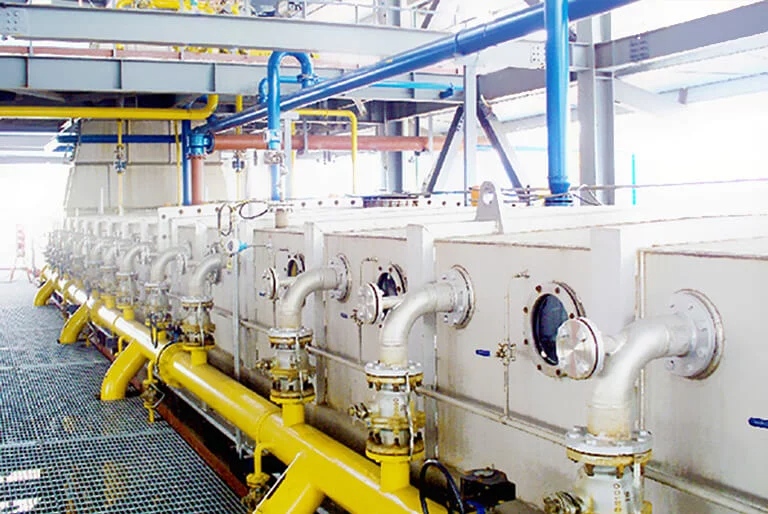
For large-scale industrial soybean oil manufacturing, solvent extraction is the standard for maximizing recovery. While mechanical pressing is suitable for smaller batches, solvent extraction ensures that the residual oil rate in the cake remains below 1%. This process relies on a kind of solvent, typically normal hexane, to absorb the oil from the prepared soybean flakes.
Advanced Extractor Configurations
The choice of extractor defines the efficiency of the entire production line. Huatai Group offers several configurations, including:
- Rotocel Extractor: Known for its simple structure and reliable operation, it is suitable for various oilseeds and offers high miscella concentration.
- Loop-type Extractor: This design allows material to turn over when moving from the upper to the lower layer, ensuring uniform and thorough extraction.
- Drag Chain Extractor: Utilized for high-capacity projects, providing excellent permeability and low residual oil.
Desolventizing and Recovery Systems
Efficiency is not only measured by oil output but also by resource recovery. The DTDC (Desolventizer-Toaster-Dryer-Cooler) system is the core soybean oil processing machine for treating the wet meal after extraction. It effectively removes residual solvent while inactivating anti-nutritional factors, making the meal safe for animal feed. Furthermore, a robust condensation and recovery system is vital for minimizing solvent loss, significantly reducing production costs.
Refining Excellence and the Process
Crude oil obtained from the extraction plant contains phospholipids, free fatty acids, and pigments that must be removed to meet food safety and quality standards. This refining stage transforms crude grease into high-grade edible oil that is stable, clear, and nutritious.
Degumming and Deacidification Technology
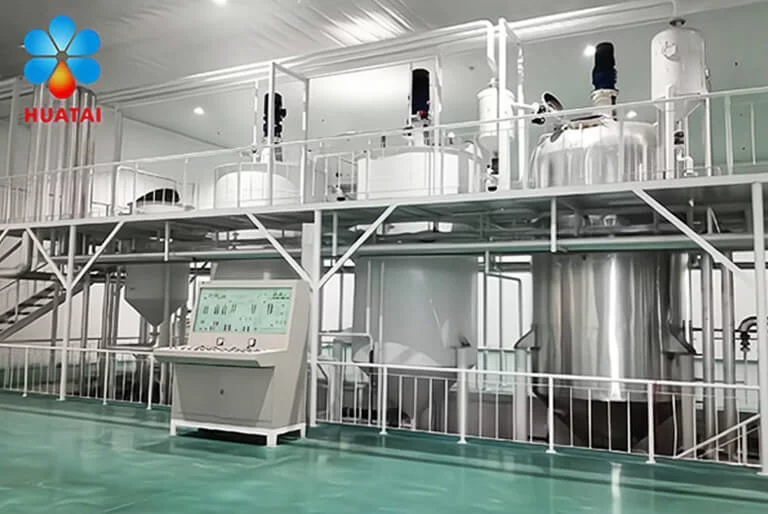
The first steps in refining are degumming and deacidification. Degumming removes peptidic impurities by adding hot water to the oil, causing the impurities to agglomerate for easy separation. Deacidification can be performed through chemical means (using an alkali solution) or physical means (using distillation in a deodorization tower). These processes are essential for preventing oil rancidity and ensuring long-term shelf stability.
Decolorization and Deodorization Technology
To achieve a crystal-clear appearance, the oil undergoes decolorization using white clay in a vacuum environment. This removes natural pigments and particulate impurities. The final stage is deodorization, conducted at high temperatures (around 260°C) under a high vacuum. This process strips away odor-carrying substances and volatile impurities. Huatai Group utilizes stainless steel deodorization towers to prevent equipment damage and ensure the highest purity of the final product.
Turnkey EPC Solutions for Global Industrial Success
Establishing a successful facility requires more than just buying a single soybean oil machine. It demands a holistic EPC (Engineering, Procurement, and Construction) solution. Huatai Group has demonstrated this expertise through numerous global projects, including a 1500TPD soybean pretreatment and extraction plant in Bolivia and a 600TPD soybean oil project for Zigong Beibu Gulf Oil Industry.
A complete turnkey solution covers:
- Initial technical consultation and site design.
- Customized equipment manufacturing and procurement.
- On-site installation, commissioning, and personnel training.
- Long-term after-sales support through 22+ overseas offices.
This integrated approach ensures that all soybean oil processing machine units work in harmony, optimizing energy consumption and maximizing the return on investment for the owner.
Conclusion
The journey from a raw soybean to a refined, high-quality edible oil is a complex process that demands precision at every turn. Success in soybean oil manufacturing is built upon the foundation of high-quality pretreatment, efficient solvent extraction, and rigorous refining standards. By partnering with an experienced soybean oil machine factory, investors can leverage advanced technology to reduce steam and power consumption while maximizing oil yield.
Contact us to receive a free customized professional plan for your next grain and oil project.
FAQ
Q: How does a modern soybean oil machine factory optimize production costs?
A: With an efficient factory such as Huatai Group, cost optimization occurs using energy-saving designs and automatic PLC controls. In this regard, the high-end pretreatment parameters reveal that the amount of steam used is ≤80Kg/T, which is substantially lower compared to the industry’s average.
Q: What is the advantage of using a Huatai Group solvent extraction plant?
A: The primary advantage is the extremely low residual oil rate, typically less than 1% in the meal. Huatai Group utilizes specialized extractors like the Rotocel and Loop-type, combined with highly efficient DTDC systems and solvent recovery units, to ensure maximum oil recovery and minimal solvent loss during soybean oil manufacturing.
Q: Can a soybean oil processing machine be used for other oilseeds?
A: Yes, many parts of the soybean oil production machinery line can be utilized flexibly. The pretreatment and extraction units can usually be modified for handling other seeds, such as peanuts, sunflower seeds, and rapeseed. Nevertheless, the particular technology and its parameters, including crushing ratio and softening temperature, depend on the features of the oilseed used.
Q: What quality standards does refined oil from a soybean oil machine meet?
A: The oil refined through a “six removal” refining process (de-gumming, de-acidification, de-watering, de-coloring, de-odorizing, and de-waxing) can meet the first-level quality standards of the extracted oil. The oil thus becomes devoid of any impurities, has no color or smell, and conforms to the international standards for food safety.